The Circle of Fifths
Step Patterns
The major scale depends on the diatonic interval pattern of whole-whole-half-whole-whole-whole-half. Again, we refer to the piano keyboard to illustrate this pattern. The C major scale is the classic example, as it uses only the natural notes (white keys), with the black keys in-between most pairs of white keys illustrating where the whole steps fall:
| |
|
|
|
|||||||||||||
| C |
D |
E |
F |
G |
A |
B |
||||||||||
If the above step pattern is somehow changed around, the scale is no longer a major scale. It might be a church mode, or something else entirely. The point is that if you wish to write in other keys than C major or A minor, you must use at least one enharmonic note, implying at least one accidental in the note picture.
If we consider the example of writing something in G major. The C major scale will, perhaps self-evidently, no longer suffice. It needs to be changed somehow. In order to preserve the diatonic intervals, the F must be raised to F sharp, providing a leading-note:
| |
|
|
F♯ |
|||||||||||||
| G |
A |
B |
C |
D |
E |
|
||||||||||
Likewise, using the notes from C major to write in F major, the fourth of the scale, B, will be augmented rather than perfect. Hence, we need to lower that note to a B flat:
| |
B♭ |
|
|
|||||||||||||
| F |
G |
A |
|
C |
D |
E |
||||||||||
(I've never seen any piano keys suddenly get wider when I've modulated from C to F or G, so this must be an artefact of my dodgy HTML/CSS programming.)
Keys in Chromatic Order
Applying proper interval theory to all the notes and being careful with the spelling of enharmonic notes, we will eventually wind up with these major/relative minor scales, sorted in ascending chromatic order:
| Keys | Accidentals |
|---|---|
| C/a | [none] |
| C♯/a♯ | 7 sharps |
| D♭/b♭ | 5 flats |
| D/b | 2 sharps |
| E♭/c | 3 flats |
| E/c♯ | 4 sharps |
| F/d | 1 flat |
| F♯/d♯ | 6 sharps |
| G♭/e♭ | 6 flats |
| G/e | 1 sharp |
| A♭/f | 4 flats |
| A/f♯ | 3 sharps |
| B♭/g | 2 flats |
| B/g♯ | 5 sharps |
| C♭/a♭ | 7 flats |
Not all enharmonic notes are represented there, but we'll get back to that (hint: none of these keys use more than seven accidentals). There seems to be some sort of polarized mirror image thing going on, right? There is a symmetry, but it's weird. It can, and will be explained, but in order to do that properly, we need to do something else.
Instead, let's sort the list of relative key pairs by ascending number of sharp accidentals, and thereby descending number of flat accidentals. Then, a circular pattern emerges:
The Circle
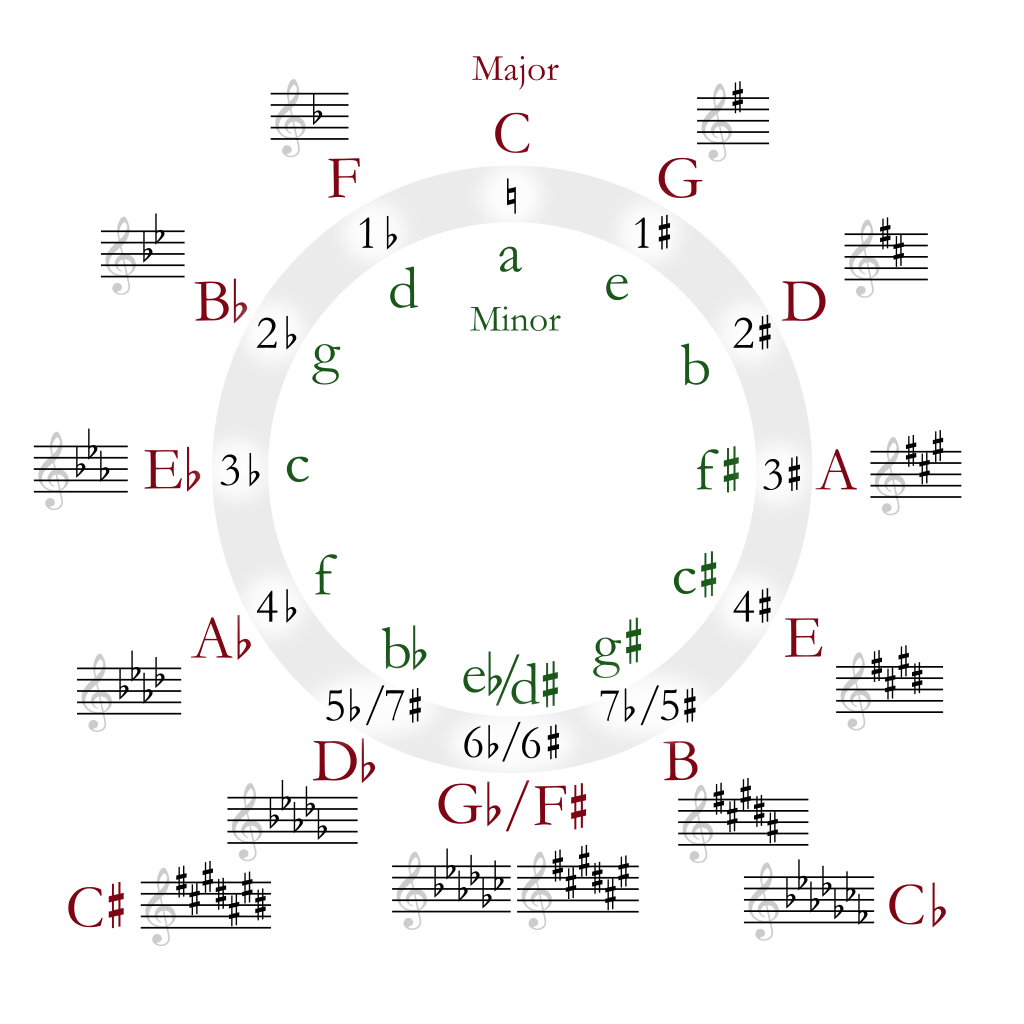
By Just plain Bill - Own work, CC BY-SA 3.0, Link
Editor's note: thanks to the Creative Commons license, I get to "borrow" this eminently clear and illustrative graphic, provided of course that I credit the creator. "Just plain Bill": I hereby dub you "Extremely helpful Bill".
The circle of fifths is a tool that musicians and theoreticians use to visualize key relationships. Keys tend to be related not necessarily by the proximity of their root notes, but rather by how many notes they have in common. The closer they appear together on the circle—and, just to be clear, this counts in either direction—the more notes in common and the closer the relation. Adjacent keys will have the maximum possible number of common notes—six. This will create an arrangement when the most closely related keys are separated by a perfect fifth—hence the name.
Here are some observations and conclusions about key relationships on the circle of fifths:
- Relative major/minor keys use the same notes and are therefore found in the same place on the circle (e.g. C major and A minor, A♭ major and F minor).
- A key is most closely related to the two adjacent keys (e.g. C major to F major or G major).
- Keys a tone apart are separated by two steps (e.g. C major to B♭ major or D major).
- A parallel minor key is always found three steps in the counterclockwise direction (C major to C minor)—add three flats or subtract three sharps.
- Conversely, a parallel major key is always found three steps in the clockwise direction (A minor to A major)—add three sharps or subtract three flats.
- Mediantic key relationships are found three (C to E♭ or A) or four (C to A♭ or E) steps apart. Interestingly, the number of semitones that separate the keys is congruent with the number of accidentals that differ.
- Keys a semitone apart are found five steps from each other (C major to C♯/D♭ major or B/C♭ major). Pick the closest route no matter whether its clockwise or counterclockwise.
- Maximum separation is six steps. There are six steps from C major to F♯ major as well as from C to G♭. Incidentally, this is a tritone relationship of six semitones.
- Bigger separation is not possible unless you forgo equal temperament and thereby enharmonic equivalence. C and C♯ might very well differ by seven accidentals, but, again: always pick the closest route. (Besides, C♯ is enharmonically equivalent to D♭.)
Circle or Spiral?
Strictly speaking, the circle of fifths is a spiral of fifths. As Bill's graphic so eminently illustrates, it gets a little crowded towards the bottom. This is not because of gravity, but because if you continue stacking fifths beyond F♯ major, you technically wind up at C♯ major, subsequently G♯ major, and so on. In the other direction, following G♭ major, you reach C♭ major and then F♭ major, etc.
The spiral becomes a circle through a clever use of musical sleight of hand: when you arrive (clockwise) at F♯ major, you renotate it enharmonically to G♭ major (which incidentally uses the same amount of accidentals), whereupon you can proceed via removing one flat per step until you wind up back at C major. For this reason, many variants of the circle of fifths do not even list the keys with seven accidentals.
Patterns of Accidentals
In the clockwise direction, removing a flat is the same thing as adding a sharp. Conversely, when going counterclockwise, removing a sharp equals adding a flat. Furthermore, there is a consistent pattern to which notes are changed when proceeding stepwise in either direction. In the sharp direction (clockwise), the fourth is raised and becomes the new seventh. In the flat direction (counterclockwise), the seventh is flattened and becomes the new fourth.
This means that there is also a system to how the sharps and flats are progressively added to the key signature. In the sharp direction, the first change is F to F♯, then C to C♯. After that, it progresses via ascending fifths (G♯, D♯, A♯, and E♯) until we arrive at the full seven sharps, where the final one added, in C♯ major, is the leading-note B♯. Going in the other direction, F major adds a B♭, B♭ major tacks on an E♭, progressing through descending fifths (B♭ – E♭ – A♭ – D♭ – G♭ – C♭) until we reach C♭ major, which adds the F♭.
Incidentally, the keys with five accidentals, B major and D♭ major (along with their relative minor keys) are the first to use all five enharmonic notes—all five black keys, as it were. After that, i.e. keys with six or more accidentals, we have to start using enharmonic equivalents of natural notes. E.g. E♯ as the leading-note in F♯ major, B♯ as the leading-note in C♯ major, C♭ as the fourth in G♭ major, F♭ as the fourth in C♭ major.
Theoretical Keys
Theoretically, the spiral of fifths continues all the way until the maximum number of double accidentals is reached in either direction: C𝄫 major, which uses seven double-flats, and C𝄪 major, which uses seven double-sharps. Note, however, that enharmonic equivalence with C major is reached already with twelve accidentals: B♯ major and D𝄫 major. Along the way, you will have encountered the sharp keys that were missing in my table above: D♯ major (nine sharps), G♯ major (eight sharps) or A♯ major (ten sharps).
These keys are commonly referred to as theoretical keys. That is, it is quite possible to use them in a piece of music, whether you simply add the accidentals next to the notes, or collect them all together in a super-complex key signature. It is normally not done, very likely because 1) there is no need, and 2) it violates the most basic tenet of music notation: keeping things simple.
In fact, even the keys with seven accidentals are rare enough in actual music. It is far more common to see D♭ major as the parallel of C♯ minor, and vice versa, same with A♭ major and G♯ minor. There might very well be pieces in keys with seven accidentals, but to deliberately seek out those that use eight or more is unnecessarily complex.